
Most people who enquire about dental implants are not really asking about titanium posts and healing times. They are asking a simpler question: will I stop thinking about my teeth?
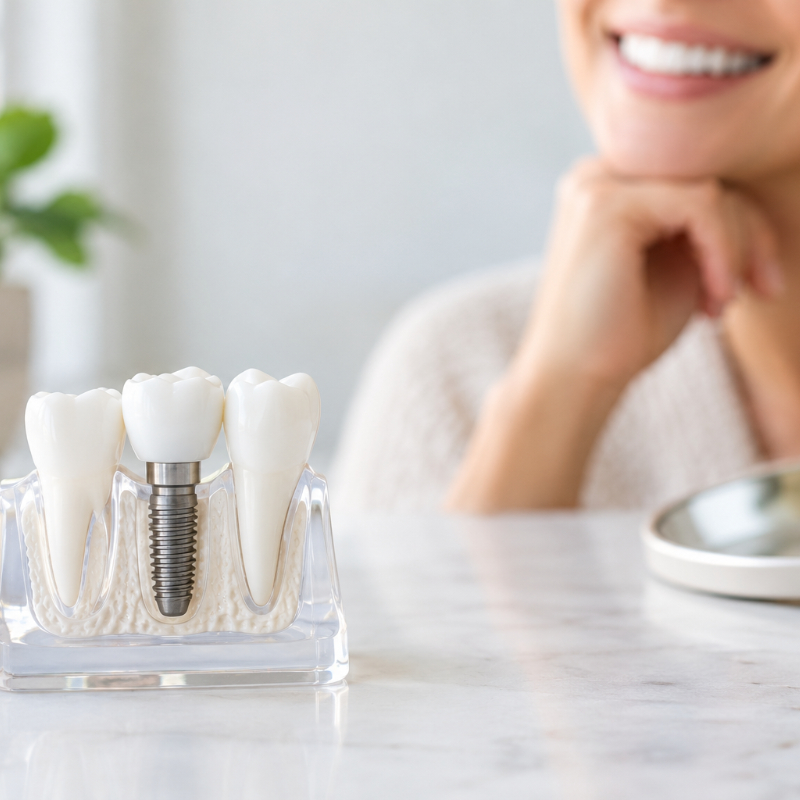
That is the honest measure of implant treatment. A dental implant replaces the root of a missing tooth with a small post that the jawbone grows around, and a crown is fitted on top of it. What changes over the following years is not just the look of a smile, it is how much daily attention the mouth demands. This guide covers what shifts and when, how long the result tends to hold, and the parts of the picture that marketing usually leaves out.
What changes first when a missing tooth is replaced
The earliest changes are practical rather than emotional. Chewing load spreads more evenly, the teeth either side of the gap stop drifting towards it, and the bone that once supported the lost tooth keeps being used instead of slowly shrinking away.
That last point matters more than it sounds. Jawbone maintains its volume because teeth transmit force into it. Once a tooth is gone, the bone beneath the gap begins to resorb, and over several years that can change the way the lower face sits and complicate any treatment attempted later. Understanding exactly how a dental implant replaces the tooth root explains why implants behave differently from a bridge or a partial denture, both of which rest on top of the gum rather than replacing what was lost underneath it.
Speech often settles within the first few weeks too, particularly where a front tooth was missing or an upper denture was covering the palate. Patients usually notice this before they notice anything about appearance.
The confidence shift is about not thinking about your teeth
Confidence after implant treatment rarely arrives as one dramatic moment in front of a mirror. It shows up as the gradual disappearance of small calculations that had become automatic.
Eating without planning around your mouth
People with missing teeth or loose dentures tend to build quiet rules for themselves. Chew on the left. Skip the steak. Avoid apples, crusty bread and anything that needs a front bite. Order something soft when eating with colleagues.
Those rules are easy to dismiss as minor until they stop being necessary. A fixed implant crown transmits bite force through the jawbone rather than resting on gum tissue, so food choice becomes a matter of taste again rather than strategy. There is a nutritional side to this as well, since long-term soft diets tend to be lower in fibre and protein than people realise. For many patients the whole question comes down to replacing a single missing tooth before the habits around it become permanent.
Speaking and smiling without a mental checklist
The second set of habits is social. Covering the mouth when laughing. Turning slightly away in photographs. Keeping a sentence short because a particular sound has become unreliable. Declining the presentation at work because speaking at length in front of people feels exposed.
When a tooth is restored in a way that stays put, those adjustments fade out over months rather than overnight. Patients commonly describe the end state as simply forgetting about it, which is a fair description of what a well-planned restoration is meant to achieve.
What the long term actually looks like
Implants are designed as a long-term replacement rather than a disposable one, and the post itself is usually the most durable part of the arrangement. Where gums stay healthy, bite forces are controlled and maintenance appointments are kept, implants commonly remain in function for many years, and a good number stay in service for decades.
The crown on top is a different matter. Like any restoration it is subject to wear, chipping and the occasional need for replacement, and it is sensible to plan on that rather than be surprised by it. Outcomes also vary with individual circumstances, so timeframes quoted anywhere, including here, are general rather than a promise about a particular case.
The realistic way to approach it is to weigh the benefits against the long-term risks before committing, rather than treating implants as a guaranteed result. Smoking, uncontrolled diabetes, untreated gum disease and heavy grinding all raise the risk of problems over time, and all of them are worth addressing before treatment rather than after.
What dental implants will not fix
This part gets skipped often, so it is worth stating plainly. Implants replace missing teeth. They do not treat the conditions that caused the tooth loss, and they are not a universal answer.
- Gum disease has to be brought under control first. An implant placed into inflamed tissue inherits the problem rather than solving it.
- An implant crown is colour-matched at the time it is made and does not respond to whitening, so any whitening of the natural teeth is better done beforehand.
- Grinding and clenching are not cured by implant treatment, and unmanaged grinding puts the restoration under load it was not designed for.
- Timeframes are measured in months, not days. Bone needs time to integrate with the implant, and shortcuts around that stage tend to be false economies.
- Implants are not always the right answer. Where neighbouring teeth already need crowns, or where bone volume is limited and grafting is not wanted, a bridge can be the more sensible choice and should be compared honestly.
Who tends to do well, and who needs more planning first
The patients who do best generally have healthy gums, enough bone to hold the implant, reasonably stable general health and a willingness to keep up maintenance appointments. Most people either meet that description or can get there with some preparation.
Where extra planning is needed, the usual reasons are bone volume, sinus position and general health. A gap left untreated for several years often means the ridge has narrowed, and in the upper back jaw the sinus can sit lower than the available bone allows. Neither rules treatment out. It simply means the sequence starts earlier, often with a procedure to rebuild bone volume before the implant goes in. Diabetes control, medications that affect bone metabolism and current smoking all need to be discussed openly at the assessment, because they change both the plan and the risk profile.
How the result is protected over the years
Implants do not decay, but the gum and bone around them can still become inflamed, and that is the main thing long-term care is aimed at preventing. Daily cleaning around the implant and regular professional reviews do most of the work.
In practice that means brushing twice a day, cleaning between the teeth with an interdental brush or floss designed for implants, and keeping scheduled maintenance appointments so the tissue around the implant can be checked properly. A night guard is often recommended for patients who grind. Bleeding gums around an implant, tenderness that does not settle or any sense of movement should be looked at promptly rather than monitored at home, and it helps to recognise the early warning signs of a failing implant so small problems are caught while they are still small.
What a first appointment in Melbourne involves
A first implant appointment is an assessment rather than a sales conversation. It covers an examination of the teeth, gums and bite, imaging where it is needed to assess bone volume and anatomy, a discussion of the suitable options including the ones that are not implants, and a written plan setting out the stages, the timeframes and the costs involved.
Patients usually leave with a clearer idea of what their own case requires, which is the point of the visit. You can read through what the implant consultation covers before booking if you would rather know the format in advance.
High Dental Implants Melbourne is based in Elsternwick and works across the range of dental implant treatments, from a single tooth through to full arch restoration, under the care of Dr Nicholas Hii. If missing or failing teeth have started shaping how you eat or how you speak, an assessment is the sensible first step.
Frequently asked questions
Do dental implants really improve confidence, or is that just marketing?
Both things are true at once. The confidence effect is real and widely reported by patients, but it comes from function rather than appearance alone. When eating, speaking and smiling stop requiring conscious adjustment, the self-consciousness attached to those moments tends to fade with it. It is a gradual change over months, not a transformation on the day the crown goes on.
How long do dental implants last?
There is no fixed figure, because it depends on gum health, bite forces, general health and maintenance. The implant post is the most durable component and commonly stays in function for many years, while the crown on top is more likely to need repair or replacement at some stage. Smoking, uncontrolled diabetes and untreated gum disease shorten the outlook considerably.
Will a dental implant feel like a real tooth?
In day-to-day use, most patients report that it does. An implant is fixed into the jawbone rather than resting on the gum, so it does not move while eating or speaking. The one difference worth knowing is that an implant has no periodontal ligament, so it does not sense pressure the way a natural tooth does. That is part of the reason professional reviews matter, since problems around an implant can develop without the usual warning ache.
Is it too late if a tooth has been missing for years?
Usually not, though it often means an extra step. Bone volume reduces after a tooth is lost, so a long-standing gap may need grafting before an implant can be placed securely. The assessment and imaging determine whether that applies, and plenty of patients who were told years ago that implants were not possible are now suitable.
What if I am nervous about the procedure?
This is one of the most common reasons people delay treatment, and it is worth raising at the first appointment rather than working around it. Anxiety is managed routinely in implant dentistry, and for patients who need it, treatment under conscious sedation is available so the procedure is more comfortable to get through.
Are dental implants worth the investment?
That depends on the alternative being compared and how long the result needs to last. Implants carry a higher upfront cost than a denture or a bridge, and they also avoid altering healthy neighbouring teeth and help maintain the bone under the gap. Current treatment and payment information is set out on the fees and finance page, and a written plan with your own costs is provided at the consultation.
Disclaimer: All treatment carries risks. Individual consultation is required with one of our practitioners to ensure that the treatment is right for you.