
There is a particular kind of tiredness that comes from wearing a denture for a long time. Not pain exactly, more a steady background effort: the adhesive, the sore spot that comes back, the sandwich you decide against, the laugh you hold back slightly in case something shifts.
Most people put up with it because they assume the alternative is not open to them at their age. That assumption is usually wrong. Age on its own is rarely what decides whether dental implants are possible, and a good number of patients in their seventies and eighties go through treatment without difficulty. This guide covers what tends to go wrong with long-term denture wear, what changes when teeth are fixed in place instead, and what the switch realistically involves.
The problems that build up after years in dentures
The difficulties with dentures are rarely dramatic. They accumulate. A denture that fitted well when it was made sits on a ridge of bone that keeps changing shape underneath it, so the fit loosens gradually over the years rather than failing all at once.
What people describe most often:
- Movement while eating, particularly with a lower denture, which has far less to hold onto than an upper one
- Sore spots that settle after a reline and then return some months later
- Growing reliance on adhesive, and more of it than used to be needed
- Food trapping underneath the plate during meals
- Certain sounds becoming less reliable, especially when speaking at length
- A quiet avoidance of eating in company
None of these is an emergency, which is exactly why they tend to go unaddressed for years. For many people the useful comparison is not dentures against implants in the abstract but how fixed teeth and removable plates differ day to day, once the novelty of either has worn off.
What actually changes when dentures are replaced or stabilised
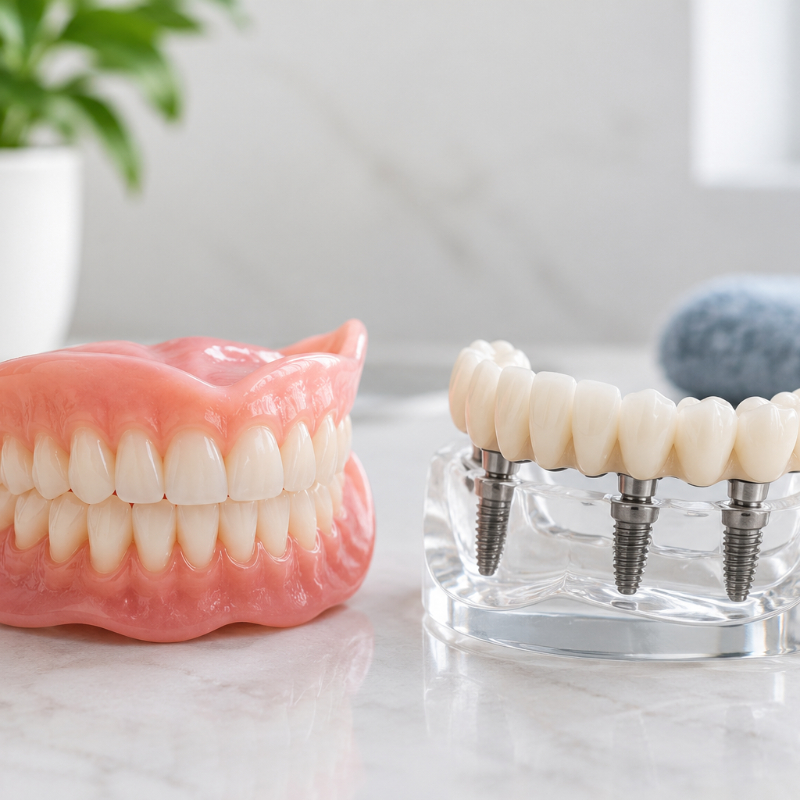
The core difference is anchorage. A denture rests on the gum and relies on suction, shape and adhesive to stay put. An implant is placed into the jawbone, which the bone then grows around, so the teeth attached to it are held by the jaw rather than balanced on top of it.
Eating properly again, and why that matters more with age
This is the change patients mention first, and nutritionally it is the one that matters most. Denture wearers commonly drift towards softer food over the years without ever deciding to. Raw vegetables go, then steak, then anything requiring a front bite, until the diet has quietly narrowed to what can be managed comfortably.
That narrowing is worth taking seriously in older adults, where protein and fibre intake already tends to drop and where appetite is often smaller to begin with. Restoring a stable bite does not fix a diet on its own, but it removes the physical reason for avoiding the foods that matter. Whether that means replacing a full arch of teeth or stabilising the denture that is already there depends on the assessment.
Speech, comfort and the end of adhesive
An upper denture covers the palate, which is the part of the mouth the tongue uses constantly for speech. Fixed teeth that do not need that coverage free the palate up, and taste often improves alongside, since the palate is also involved in how food is experienced.
The adhesive routine disappearing is a smaller thing on paper and a large one in practice. So does taking something out at night, soaking it, and the private business of cleaning it. For a lot of patients, that is the part they describe as getting their dignity back, and it is a reasonable thing to want.
The bone change happening underneath a denture
This is the part most denture wearers have never had explained to them, and it is the strongest argument for not leaving the decision indefinitely. Jawbone keeps its volume because teeth transmit chewing force into it. Once the teeth are gone, that stimulus goes with them, and the ridge gradually resorbs.
That is why a denture that fitted well needs relining, and then relining again. The denture has not changed shape. The jaw underneath it has. Over a long enough period, the ridge can flatten to the point where a lower denture has very little left to grip, and where implant placement needs more preparation than it would have done earlier.
An implant interrupts that process locally, because it transmits load into the bone the way a tooth root did. Where the ridge has already reduced significantly, the usual answer is building the bone back up before an implant goes in, and in the upper back jaw a procedure to lift the sinus floor may be needed as well. Neither rules treatment out. Both add time, which is a reason to have the conversation sooner rather than later.
Is 70 or 80 too old for dental implants?
No. There is no upper age limit for dental implants, and age by itself is not what determines suitability. What matters is bone volume, gum health, general health and the medications being taken. A healthy 80-year-old is frequently a better candidate than a 50-year-old with uncontrolled gum disease.
The reasoning in older patients is often more favourable than people expect. Bite forces tend to be lower, the problems caused by long-term denture wear are already present, and the quality of life improvement from eating and speaking comfortably is immediate rather than theoretical. The honest way to decide is to weigh the benefits against the risks for your own situation with a practitioner who has examined you, rather than from an article.
Health conditions and medications that need discussing first
Some medical history changes the plan, and some changes whether treatment goes ahead at all. Nothing here is a reason to avoid the conversation, but all of it needs to be on the table at the assessment rather than discovered later.
Worth raising at the first appointment:
- Diabetes, and how well controlled it currently is, since healing is affected
- Medications that affect bone metabolism, including some osteoporosis treatments, which need specific discussion before any surgery involving the jaw
- Blood thinning medication, which does not usually prevent treatment but does change how it is managed
- Current smoking, which measurably raises the risk of implant problems
- Any history of radiotherapy to the head or neck
- Dry mouth, which is common with age and with many medications, and which affects both denture comfort and implant maintenance
Bring a full list of current medications to the appointment. It is more useful than trying to recall them, and it shapes the plan from the start. Patients who find dental treatment stressful should also know that treatment under conscious sedation is available, which makes the surgical stage considerably easier to get through.
You do not have to choose between a denture and a full set of implants
This is the most common misunderstanding, and it stops people enquiring. The choice is not between the denture you have now and replacing every tooth with an implant. There is a middle ground, and for many older patients it is the right answer.
A small number of implants can be used to anchor a denture so that it clips firmly into place instead of resting loose on the gum. The denture still comes out for cleaning, but it no longer moves while eating or speaking and adhesive is no longer needed. It costs considerably less than a full set of individual implants and usually needs fewer implants placed, which also means less surgery.
At the other end, a fixed full arch restoration supported by several implants stays in permanently and is cleaned in the mouth like natural teeth. Which of these suits a given patient depends on bone, budget, general health and preference, and the options are set out properly in the guide to choosing between removable and fixed teeth.
What the first appointment covers
The first appointment is an assessment, not a sales conversation. It covers an examination of the gums, the ridge and the existing denture, imaging to measure available bone, a discussion of which options are realistic in your case, and a written plan with stages, timeframes and costs.
Patients generally leave knowing whether treatment is possible for them and roughly what it would involve, which is the point of the visit. You can read through what the implant consultation covers beforehand if you would rather know the format in advance.
High Dental Implants Melbourne is in Elsternwick and works across the full range of dental implant treatments under the care of Dr Nicholas Hii, from stabilising an existing denture through to full arch restoration. If your denture has reached the point where you plan your meals around it, that is a reasonable moment to find out what else is possible.
Frequently asked questions
Can you get dental implants after wearing dentures for years?
Usually yes. Long-term denture wear does not prevent implant treatment, though it often means the ridge has reduced and some bone rebuilding is needed first. The assessment and imaging determine whether that applies in your case. Plenty of patients who were told years ago that implants were not an option for them turn out to be suitable now.
Is there an age limit for dental implants?
No. Suitability is decided on bone volume, gum health, general health and current medications, not on a birthday. Patients in their seventies and eighties are treated routinely. What matters is that any medical conditions and medications are discussed openly before treatment is planned.
Can my existing denture be made to stay in place?
Often, yes. A small number of implants can be placed to anchor a denture so it clips securely rather than sitting loose on the gum. It still comes out for cleaning, but it stops moving while eating and talking, and adhesive is no longer needed. In some cases the current denture can be adapted rather than replaced entirely, which the assessment will establish.
Does getting dental implants hurt?
The procedure itself is carried out under local anaesthetic, so it is not painful at the time. Afterwards, there is usually some swelling and tenderness for a few days, managed with ordinary pain relief. Patients who are particularly anxious about dental treatment can discuss conscious sedation, which makes the appointment much easier to get through.
How long does the whole process take?
Months rather than weeks, because the bone needs time to integrate with the implant before the final teeth are fitted. The exact timeline depends on whether bone grafting is needed and on how many implants are being placed. Temporary teeth are generally provided in the meantime, so nobody is left without.
Are implants worth it compared with just getting a new denture?
It depends on what is driving the decision. A new denture is faster and costs less upfront, and for some patients that is the sensible answer. Implants cost more and take longer, and in return they hold the teeth in place, remove the adhesive routine and help maintain the bone underneath. Current treatment and payment information is on the fees and finance page, and a written plan with your own costs comes out of the consultation.
Disclaimer: All treatment carries risks. An individual consultation is required with one of our practitioners to ensure that the treatment is right for you.