
| ANSWER-FIRST BLOCK (publish directly under the H1, above the first H2)
Conscious sedation uses controlled medication to keep you deeply relaxed during implant surgery while you remain able to respond, with local anaesthetic numbing the treatment area. It is monitored throughout by trained clinical staff, and most patients remember little of the procedure. Your suitability is confirmed at your assessment. See our conscious sedation options. |
If the idea of implant surgery makes your stomach turn over, you are in ordinary company. Dental anxiety is common among adults, and for some people it is strong enough that treatment gets postponed for years, sometimes long after a tooth has already been lost. Nobody at High Dental Implants Melbourne is going to tell you that feeling is irrational.
What we can do is explain exactly what happens, because for most anxious patients the fear is really about the unknown. Conscious sedation is one of the tools that makes implant treatment manageable at our Elsternwick clinic, and this guide sets out what it is, how it works during an appointment, how it is monitored, and what the rest of your day looks like afterwards.
What conscious sedation is, and what it is not
There are three distinct levels of comfort management in dentistry, and they are frequently confused with one another.
Local anaesthetic numbs the specific area being treated. You are fully awake and aware throughout; you can feel pressure and movement but not sharpness, and it is used in almost every implant procedure regardless of what else is added alongside it.
Conscious sedation adds medication that produces a deeply relaxed, drowsy state on top of that numbing. You are not unconscious. You can still respond to instructions and questions, and you keep breathing on your own, but time passes very differently, and most people recall very little afterwards. Sedation may be delivered through an intravenous line or by other means depending on what suits you.
General anaesthetic renders a patient fully unconscious and is administered by an anaesthetist, usually in a hospital or day-surgery setting. It is a different level of care again. When people use the phrase sleep dentistry, they are often describing conscious sedation rather than a general anaesthetic, which is worth clarifying when you compare what different clinics offer.
Sedation is also not a replacement for numbing. The two work on different things. Local anaesthetic deals with sensation at the tooth and gum, while sedation deals with how you experience the appointment, so the two are used together rather than as alternatives to one another.
How sedation is used during implant treatment
A sedation appointment follows a predictable shape, and knowing that shape is often reassuring in itself.
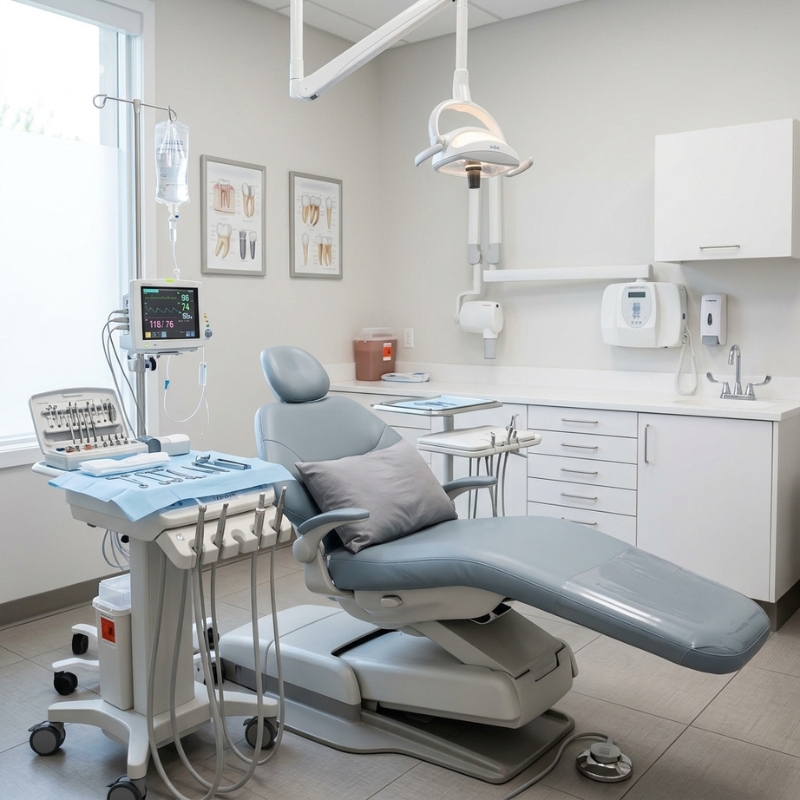
You will be given written preparation instructions beforehand, which typically cover fasting, your regular medications and arranging someone to take you home. On the day, the clinical team confirms your medical history and health status before anything begins, then applies monitoring equipment. Local anaesthetic is administered to numb the treatment area, and the sedation is started and adjusted gradually.
From your point of view, the sensation is usually one of becoming very relaxed and detached, as if you were half asleep. The dental implant treatment itself proceeds exactly as planned. You may be aware of voices or movement, and you can respond if asked to open a little wider, but the anxiety that would normally accompany that awareness is largely absent. Many patients are surprised at how quickly the appointment seems to have passed.
Because sedation changes how you experience time, longer appointments become far more tolerable. That is particularly relevant for implant treatment, where placing several implants or combining an extraction and a graft in one visit can mean a longer session in the chair. For anxious patients, consolidating work into fewer, longer appointments is often preferable to spreading it across many shorter ones.
Is conscious sedation safe?
Conscious sedation is a well-established part of dental practice in Australia and is governed by professional standards covering training, equipment and monitoring. It is not something added casually to an appointment.
Before sedation is offered, your medical history is reviewed in detail. Existing conditions, current medications, allergies, previous reactions to sedation or anaesthetic, and your general health all feed into whether sedation is appropriate for you and which approach suits. Some patients are advised that a different setting is more suitable, and that assessment happens before the day of treatment rather than on it.
Throughout the procedure your oxygen levels, heart rate, blood pressure and breathing are monitored continuously by trained clinical staff whose attention is on those readings. Sedation is adjusted in response to what the monitoring shows. Afterwards you are observed in the practice until you are alert enough to be discharged into the care of the person taking you home.
You are also asked about sedation at the planning stage rather than being presented with it on the day. That gives you time to ask questions, arrange your transport home and organise time off work if you need it, and it gives the team time to confirm that the approach chosen suits your medical history.
Getting home and aftercare
You will need a responsible adult to accompany you home and, ideally, to stay with you for the remainder of the day. This is not optional. You cannot drive yourself, and taking public transport or a taxi alone is not appropriate after sedation.
Drowsiness usually eases over the hours following your appointment, though judgement and coordination can be affected for longer than you might expect. For the rest of that day, avoid driving, operating machinery, drinking alcohol and signing anything important. Plan a quiet afternoon and eat lightly.
Most patients feel much more like themselves by the next morning and return to normal activities, following the specific aftercare instructions for the implant surgery itself. Your team will tell you who to contact if anything concerns you overnight.
It is worth arranging your day around this in advance. Book the appointment when you can afford a quiet evening, organise your lift before the day rather than on it, and have soft food at home so you are not making decisions about dinner while still drowsy. Small preparations remove most of the friction from the afternoon afterwards.
Frequently Asked Questions
Will I feel any pain with conscious sedation?
The treatment area is numbed with local anaesthetic, and the sedation keeps you deeply relaxed on top of that. Most patients report being comfortable throughout and recalling very little. You remain able to respond, so you can let the team know at any point if something feels uncomfortable.
Is conscious sedation safe?
Conscious sedation is well established in Australian dental practice and delivered under professional standards for training and monitoring. Your medical history is reviewed before it is offered, and your breathing, oxygen levels, heart rate and blood pressure are monitored continuously by trained clinical staff throughout the procedure.
How long do the effects last?
The deepest effects wear off within a few hours, but drowsiness and reduced coordination can linger for the rest of the day. You should not drive, drink alcohol or make important decisions during that period. Most patients feel back to normal by the following morning.
Can I drive home afterwards?
No. You must arrange for a responsible adult to take you home and, where possible, stay with you for the rest of the day. Driving, cycling and travelling alone are all unsuitable after sedation, so it is worth organising this before your appointment.
Treatment you can actually go through with
Anxiety about dental surgery is a real obstacle, and leaving a missing tooth untreated because of it carries its own consequences for the surrounding teeth and bone. Conscious sedation exists precisely so that nervousness does not have to be the reason treatment never happens.
The first step is a conversation rather than a procedure. Tell us how you feel about treatment and we will talk through what suitable comfort options look like for you. You can book an implant consultation at our Elsternwick clinic, or see conscious sedation options at High Dental Implants Melbourne.